Polaroid Go Generation 2 Instant Camera Review 2026: Worth Your Money?
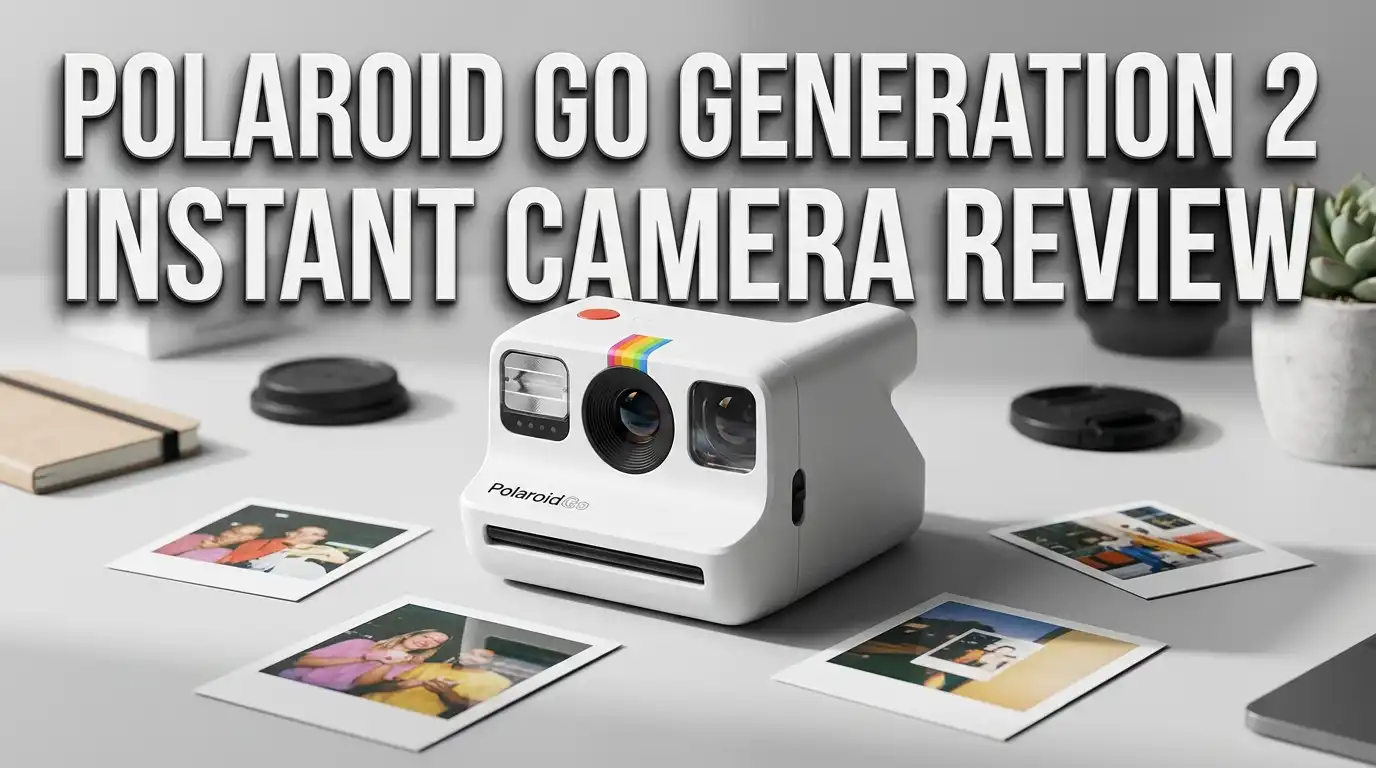
The Polaroid Go Generation 2 is the world’s smallest analog instant camera. It fits in your pocket, looks adorable, and promises bright instant photos with creative features. But does it deliver on those promises?
But here is the big question. Does this camera take good enough photos to justify the cost of film? Is it better than the popular Fujifilm Instax Mini 12? And should you spend your hard-earned money on it in 2026?
This detailed review covers every angle. You will learn about its design, photo quality, film costs, battery life, and much more.
Key Takeaways
- The Polaroid Go Gen 2 is the smallest instant camera available today. It measures just 3.3 by 4.1 by 2.4 inches and weighs only 8.4 ounces. You can slip it into almost any pocket, purse, or small bag with ease.
- Photo quality is inconsistent and often disappointing. The camera struggles with exposure accuracy, color shifts, and backlit scenes. The weak flash does not illuminate subjects well in low light. Many users report that results feel unpredictable.
- Film costs add up quickly. Polaroid Go film costs about $1.25 per photo. Each cartridge holds only 8 shots. This is significantly more expensive than Fujifilm Instax Mini film, which costs around $0.70 per shot.
- Creative features are a real highlight. The built-in double exposure mode, self-timer, and selfie mirror add genuine fun and creative value. These features set it apart from basic competitors like the Instax Mini 12.
- USB-C charging is a welcome upgrade over the original model. The Gen 2 replaces the old micro USB port with USB-C. However, real-world battery life falls short of the promised 120 shots per charge.
- The Fujifilm Instax Mini 12 remains a better overall value for most buyers. It produces more consistent colors, uses cheaper film, and delivers a larger image area.
Polaroid Go Generation 2: Design and Build Quality

- Wearable and take anywhere-able: As the Polaroid’s smallest instant camera, the Polaroid Go fits...
- Takes clearer, brighter, even nicer pictures: Thanks to the large aperture range, precise light...
Last update on 2026-10-25 / Affiliate links / Images from Amazon Product Advertising API
The Polaroid Go Generation 2 has a design that turns heads. It is incredibly small and lightweight. You can hold it comfortably in one hand, and it feels sturdy despite its compact plastic body.
The camera comes in several color options. You can choose from black, white, blue, red, and purple. Every color features the iconic Polaroid rainbow stripe logo on the front. The bright red shutter button adds a playful touch.
Polaroid built this camera with 30% recycled materials. The overall construction uses quality plastic that does not feel cheap or flimsy. The film door sits on the bottom and includes helpful arrows for easy film loading.
The retro aesthetic works perfectly with the palm-sized form factor. It looks like a miniature version of a classic Polaroid camera. People will notice it and ask about it. That alone makes it a great conversation starter at parties and events.
How Does the Polaroid Go Gen 2 Perform in Real Life?
Real-world performance is a mixed bag with this camera. The Go Gen 2 uses a 51mm polycarbonate resin lens with a fixed focus. It covers a moderately wide angle of about 65 degrees diagonally.
The aperture range spans from f/9 to f/42. The shutter speed ranges from 1 second to 1/300 second. Both settings are fully automatic. You point, you shoot, and the camera decides everything for you.
This simplicity sounds great on paper. However, the automatic light meter often misjudges scenes. Photos come out too bright or too dark with surprising frequency. Backlit subjects are a particular problem.
The camera performs best in evenly lit, daylight conditions. Indoor shots with good artificial lighting also turn out decent. But tricky lighting conditions will challenge this camera beyond its abilities.
Photo Quality: The Honest Truth
Photo quality is the most important factor for any camera. Unfortunately, the Polaroid Go Gen 2 delivers inconsistent results in this department.
Images sometimes look bright, detailed, and charming. Other times, they show heavy color casts, poor exposure, and soft details. The plastic lens produces noticeable softness, especially near the edges of the frame.
The flash is weak. It struggles to properly illuminate subjects even at moderate distances. Low-light photography produces dim, underexposed images. Fill flash in backlit situations does not perform well either.
Color accuracy varies depending on temperature and lighting. Cold days can produce a blue cast. Warm days may shift colors in the other direction. This inconsistency makes it hard to trust the camera for important moments.
The prints themselves measure 2.6 by 2.1 inches total. A thick white border reduces the actual image area to just 1.8 inches square. That is quite small, even by instant camera standards.
Polaroid Go Film: Cost and Availability

- Wearable and take anywhere-able: As the Polaroid’s smallest instant camera, the Polaroid Go fits...
- Takes clearer, brighter, even nicer pictures: Thanks to the large aperture range, precise light...

Last update on 2026-10-25 / Affiliate links / Images from Amazon Product Advertising API
Film cost is a major consideration with any instant camera. The Polaroid Go uses its own proprietary film format. No other brand makes compatible film.
Each Go film cartridge holds 8 photos. Polaroid sells packs of two cartridges (16 shots) for about $20. That breaks down to roughly $1.25 per single photo.
This price point is significantly higher than Fujifilm Instax Mini film. Instax Mini film costs about $0.70 per shot. Over time, this difference adds up fast, especially if you shoot frequently.
The film also requires careful handling during development. You must shield Go film from light during the first few minutes of its 20-minute development time. Polaroid includes a small opaque shield for this purpose, but it adds an extra step that Instax film does not require.
Film availability is generally good at major retailers and online stores. However, the limited format means you have fewer creative options. There is no black-and-white Go film available, for example.
Top 3 Alternatives for Polaroid Go Generation 2
1. Fujifilm Instax Mini 12

- Compact and cute design. Easily twist the lens to turn on and off
- Built-in selfie mirror for easy selfies Close-up mode with parallax correction
Last update on 2026-10-25 / Affiliate links / Images from Amazon Product Advertising API
The Instax Mini 12 is the most popular entry-level instant camera on the market. It produces consistent, bright photos with accurate colors. Film costs only $0.70 per shot. It is easy to use, available in fun pastel colors, and widely recommended by reviewers.
2. Polaroid Now 2nd Generation

- NEW NOW INSTANT CAMERA: Capture and keep your everyday moments forever with the Polaroid Now i-Type...
- NEW & IMPROVED: Our new Now Generation 2 analog instant camera is now made with 40% recycled...
Last update on 2026-10-25 / Affiliate links / Images from Amazon Product Advertising API
The Polaroid Now Gen 2 uses the larger I-Type film format with a 3.0-inch square image area. It offers autofocus with two lenses, a self-timer, and double exposure mode. Photos are larger and more impactful. It costs more per shot but delivers a true Polaroid experience.
3. Kodak Mini Shot 3 Retro

- 2-in-1 Instant Camera & Printer: The KODAK Mini Shot 3 Retro combines an instant camera and portable...
- Genuine 4PASS dye sublimation printing: Each photo is produced in three color layers and finished...
Last update on 2026-10-25 / Affiliate links / Images from Amazon Product Advertising API
The Kodak Mini Shot 3 Retro doubles as a camera and photo printer. It connects to your phone via Bluetooth. It uses 4PASS dye-sublimation technology for smudge-proof, water-resistant 3×3 inch prints. It offers a digital-analog hybrid approach that many users appreciate.
Battery Life and Charging
The Polaroid Go Gen 2 uses a built-in rechargeable lithium-ion battery. It charges through a USB-C port on the side of the camera. This is a welcome upgrade from the original Go, which used the older micro USB standard.
Polaroid claims the battery supports up to 120 photos on a single charge. That would equal 15 full film packs. Real-world performance tells a different story, though.
Multiple reviewers and users report the battery running low after about 30 to 40 shots. Some users on Reddit have reported getting only 10 to 12 photos from a full charge. This is far below the official claim.
A red indicator light warns you when the battery is getting low. Charging time is reasonable, and you can top it off between shooting sessions with any USB-C cable. Still, the gap between promised and actual battery life is disappointing.
Selfie Mirror and Self-Timer Features
The Polaroid Go Gen 2 includes a built-in selfie mirror on the front of the camera. It uses a two-way mirror finish on the optical viewfinder. You can see your reflection on the viewfinder’s exterior surface while snapping a selfie.
This is a clever design choice that saves space. However, it has a downside. The two-way mirror can sometimes show reversed ghost reflections when you look through the viewfinder from behind. This happens most often in bright environments with lots of reflective surfaces.
The self-timer gives you about 10 seconds to get into position. This is great for group shots and solo selfies. You will need a flat surface to set the camera down since there is no tripod mount.
Both features add genuine value to the camera. They make it more versatile than a basic point-and-shoot instant camera. The selfie mirror is especially handy for social events and travel.
Double Exposure Mode Explained
Double exposure is one of the most creative features on the Polaroid Go Gen 2. It lets you combine two separate images on a single frame of film.
To activate it, lightly tap the Flash button. The film counter LED will flash a “1” to signal that double exposure mode is active. Take your first shot, then take your second. The camera ejects and develops the film after the second photo.
The results can be artistic, dreamy, and surprising. You can overlay a portrait with a texture, combine two faces, or blend a landscape with a close-up subject. Creative experimentation is the whole point.
You can even take triple or quadruple exposures with a simple trick. Turn the power off after the first shot. Then turn it back on and reactivate double exposure mode. This stacks additional images onto the same frame.
The Fujifilm Instax Mini 12 does not offer double exposure at all. This gives the Polaroid Go Gen 2 a clear creative advantage over its main competitor.
Polaroid Go Gen 2 vs. Fujifilm Instax Mini 12
This is the comparison most buyers want to see. Both cameras retail for about $80. Both target casual shooters and instant photography beginners. But they differ in important ways.
Photo quality goes to the Instax Mini 12. It delivers more consistent exposures, more accurate colors, and a larger image area (1.8 x 2.4 inches vs. 1.8 x 1.8 inches). Instax film handles more reliably and does not require shielding from light.
Film cost also favors the Instax Mini 12. At $0.70 per shot versus $1.25, you save significantly over time. This matters because instant cameras eat through film quickly.
Size and portability go to the Polaroid Go Gen 2. It is noticeably smaller and lighter. It fits in places the Instax Mini 12 simply cannot.
Creative features favor the Polaroid Go Gen 2. Double exposure mode and the self-timer add creative options. The Instax Mini 12 has a close-up mode but lacks double exposure.
For most people, the Instax Mini 12 is the better overall value. But if size and creative features matter most to you, the Go Gen 2 has real appeal.
Who Should Buy the Polaroid Go Generation 2?
This camera is not for everyone. It works best for a specific type of user with specific expectations.
You should buy it if you value extreme portability above all else. The Go Gen 2 fits in your palm. It goes everywhere you go. If you want the world’s tiniest instant camera, this is literally your only option.
You should buy it if you love the Polaroid brand aesthetic. The retro design, the rainbow stripe, the small square prints. These things have a genuine charm that no other brand replicates.
You should buy it if you enjoy creative experimentation. Double exposures, self-timer tricks, and the unique Go film format offer a distinct creative playground.
You should skip it if you want reliable photo quality. The inconsistent exposure, weak flash, and color shifts will frustrate you. You should also skip it if you are budget-conscious about film costs. The ongoing expense of Go film adds up fast.
How to Get the Best Photos from Your Polaroid Go Gen 2
If you already own this camera or plan to buy it, these tips will help you get better results.
Shoot in bright, even daylight whenever possible. The camera performs best with plenty of ambient light. Avoid strong backlighting and mixed lighting scenes.
Shield your film immediately after it ejects. Place it face-down in a dark pocket or bag. This prevents light exposure during the 20-minute development period. Skipping this step will cause washed-out, low-contrast images.
Keep the lens clean. The small plastic lens picks up fingerprints and smudges easily. Use a soft microfiber cloth to wipe it before each shooting session.
Pay attention to your distance from subjects. The fixed-focus lens works best at distances between 2 feet and infinity. Getting too close will produce blurry results.
Warm your film before loading it. In cold weather, keep film packs in an inside pocket close to your body. Cold film produces color casts and slower development times.
Polaroid Go Gen 2 Specifications at a Glance
Here are the key technical details for the Polaroid Go Generation 2 instant camera.
The lens is a 51.1mm polycarbonate resin element with a 65-degree diagonal field of view. The aperture range covers f/9 to f/42. The shutter speed ranges from 1 second to 1/300 second. All exposure settings are fully automatic.
The camera weighs 8.4 ounces (240 grams) and measures 3.3 by 4.1 by 2.4 inches. It uses Polaroid Go film with an image area of 1.8 inches square. Each film cartridge holds 8 exposures.
The flash is built-in with an effective range of about 1.6 feet to 8.2 feet. The battery is a rechargeable lithium-ion cell with USB-C charging. The camera includes a wrist strap and USB-C cable in the box.
The retail price is approximately $79.99 for the camera only. Bundle options with film packs cost around $99.99.
Is the Polaroid Go Generation 2 Worth It in 2026?
The honest answer depends on what you want from an instant camera. The Polaroid Go Gen 2 excels at being small, cute, and fun to carry around. It has real creative features that competitors lack.
But the photo quality is genuinely disappointing for a camera at this price point. The high cost of film makes every bad shot sting a little more. When you pay $1.25 per photo, you expect more consistent results.
If Polaroid updated the lens, improved the flash, and reduced film prices, this camera could be a genuine winner. Right now, it is a style-over-substance product that works better as a fashion accessory than a serious camera.
For pure value, the Fujifilm Instax Mini 12 remains the smarter choice. For creative Polaroid lovers who accept the trade-offs, the Go Gen 2 still has a place.
Final Verdict: Polaroid Go Generation 2
The Polaroid Go Generation 2 is the most adorable instant camera you can buy. Its tiny size and retro design are genuinely delightful. The double exposure mode and self-timer add creative value that budget competitors lack.
However, the camera falls short where it matters most. Photo quality is unpredictable. The flash is weak. Film costs are high. Battery life does not meet the official claims. And the tiny print size limits the impact of your images.
This camera earns a recommendation for die-hard Polaroid fans and collectors who prioritize portability and style. For everyone else, better options exist at the same price point. The Fujifilm Instax Mini 12 delivers more consistent photos at a lower per-shot cost.
Rating: 3 out of 5 stars. A charming camera held back by inconsistent performance and expensive film.
Frequently Asked Questions
Is the Polaroid Go Gen 2 better than the original Polaroid Go?
Yes, the Gen 2 is a modest improvement. It switched from micro USB to USB-C charging. Photos tend to be slightly brighter and more consistent. However, the core experience and film format remain the same. The upgrade is incremental rather than transformative.
What size photos does the Polaroid Go Generation 2 produce?
The prints measure 2.6 by 2.1 inches in total. The actual image area is a 1.8-inch square after accounting for the white border. These are the smallest Polaroid prints available and are roughly credit-card sized.
How much does Polaroid Go film cost per photo?
Polaroid Go film costs about $1.25 per photo. A double pack of two cartridges (16 photos total) retails for approximately $20. This is more expensive than Fujifilm Instax Mini film, which averages about $0.70 per shot.
Can you use regular Polaroid film in the Polaroid Go Gen 2?
No. The Polaroid Go Gen 2 uses only Polaroid Go film. It is not compatible with I-Type film, 600 film, or any Fujifilm Instax format. The Go film is a proprietary format exclusive to the Go camera line.
Does the Polaroid Go Gen 2 have Bluetooth or app connectivity?
No. The Polaroid Go Gen 2 is a fully analog camera with no Bluetooth, Wi-Fi, or app connectivity. If you want app-controlled creative features, consider the Polaroid Now+ Gen 2, which offers Bluetooth and manual controls through the Polaroid app.
How long does it take for Polaroid Go photos to develop?
Polaroid Go photos take approximately 15 to 20 minutes to fully develop. You should shield the film from light immediately after it ejects from the camera. Place it face-down in a dark area for the best results. Exposure to light during development causes faded, low-contrast images.

Hi, I’m Kate! As a tech journalist and gadget enthusiast, I’ve been exploring the intersection of artificial intelligence and consumer technology for over a decade. My passion lies in translating complex tech concepts into practical insights that actually matter to real people.