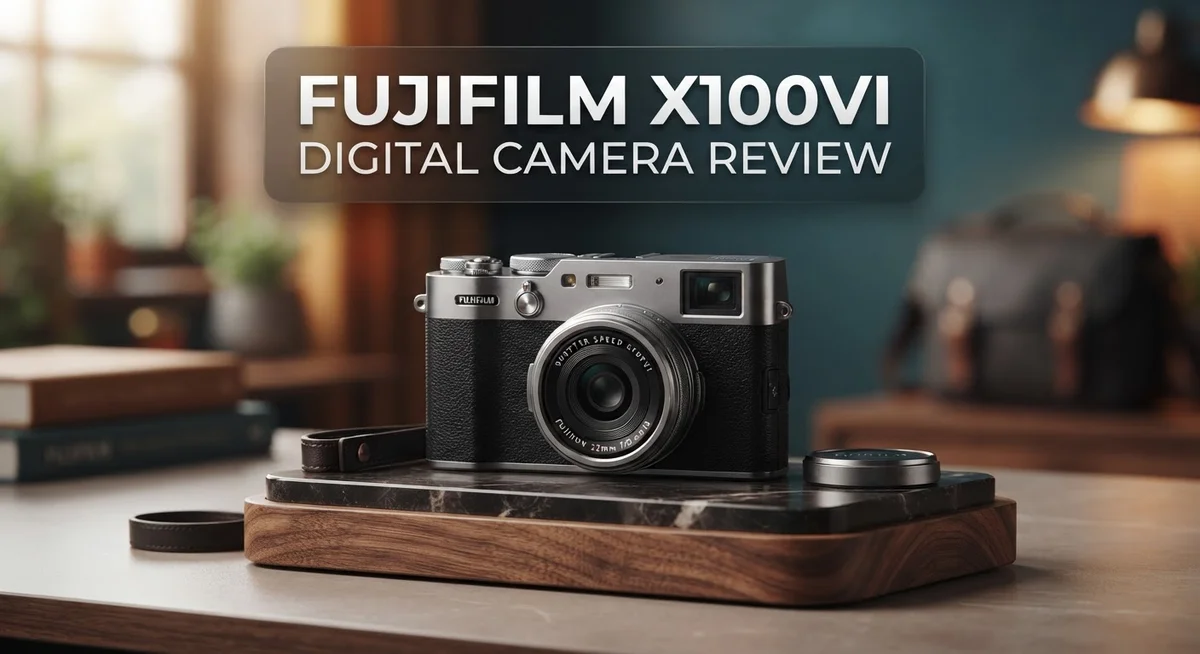
Fujifilm X100VI Digital Camera Review: Should You Buy This?
The Fujifilm X100VI turns heads wherever it goes. This compact camera packs a 40MP sensor into a body that fits in your pocket. It feels like a modern classic reborn.
Photographers love its fixed 23mm lens. It captures sharp, detailed images with ease. The manual dials for ISO, aperture, and shutter speed give you full creative control.
Video shooters will notice a big leap forward too. The X100VI now supports 6.2K and 4K footage. This makes it a significant upgrade from the X100V.
But no camera is perfect. The autofocus system feels outdated compared to rivals. Some users find it frustrating, especially in fast moving scenes.
Still, its blend of style and performance is hard to ignore. Is the Fujifilm X100VI the right camera for your next adventure? Let us break down every detail so you can decide.
In a Nutshell
- The 40MP sensor captures fine detail and sharp images every time.
- A quiet leaf shutter lets you shoot candid moments without drawing attention.
- Built-in flash gives you extra flexibility in low light.
- Manual dials for ISO, aperture, and shutter speed put full control in your hands.
- The 1.62M dot LCD screen shows bright, clear previews of your shots.
- Instant power-on means you never miss a spontaneous moment.
Sensor and Image Quality
The 40MP sensor sits at the heart of the X100VI’s image quality story. This sensor captures exceptional detail and produces sharp, vibrant photos in most lighting conditions. Colors feel natural and punchy without looking oversaturated or artificial.
Dynamic range performance stands out. The camera handles bright skies and dark shadows reasonably well. You get good separation between tones, which means your photos look balanced and professional. Shadows retain detail instead of turning into black blobs. Highlights stay controlled rather than blowing out into white patches.
ISO performance deserves attention here. The X100VI handles sensitivity levels from 160 to 12,800 with confidence. Lower ISOs produce clean, noise-free images. Mid-range ISOs stay usable for most situations. Higher ISOs introduce some grain, but it looks film-like rather than digital and harsh. This character appeals to photographers who love the classic film aesthetic.
The fixed 23mm lens works in tandem with the sensor to create a specific shooting experience. This focal length falls between standard and slightly wide. It encourages you to move closer to your subjects rather than zoom from far away. This forces intentional composition. You think more carefully about framing and subject placement.
Autofocus performance impacts image quality indirectly. While the AF system feels outdated and slow, it still locks onto subjects eventually. Fast-moving action tests your patience. Static subjects pose no real problem. Manual focus gives you an escape route when the autofocus frustrates you.
Video capabilities show real improvement over the previous X100V model. The camera records 6.2K at 30fps and 4K at 60fps. Video color science matches the still image quality. Footage looks smooth and detailed. The quiet leaf shutter means minimal audio interference during recording. This matters for vloggers and documentary shooters who need clean sound.
Overall sensor and image quality feel premium. The X100VI produces images that satisfy photographers who care about technical excellence and artistic vision. The 40MP resolution gives you room to crop and enlarge prints. The color rendering feels authentic to Fujifilm’s reputation. This camera rewards careful composition and deliberate shooting habits.

- 40.2MP X-Trans CMOS 5 HR Sensor
- Up to 6.0 stops In-Body Image Stabilization
Last update on 2026-10-25 / Affiliate links / Images from Amazon Product Advertising API
Design, Build and Handling
The X100VI feels like a camera built for real photographers. Its body strikes a perfect balance between portability and substance. You can slip this camera into a jacket pocket or small bag without thinking twice.
The design philosophy here is straightforward. Fujifilm kept the classic rangefinder aesthetic that made the X100 series famous. The camera sits comfortably in your hands thanks to its grip texture and weight distribution.
Manual dials dominate the top plate. You get dedicated controls for ISO, aperture, and shutter speed. Adjusting these settings happens without diving into menus. This tactile approach appeals to photographers who prefer mechanical feedback over digital scrolling.
The build quality feels solid throughout. The metal chassis resists bumps and daily wear. The lens barrel has a satisfying click when you rotate the focus ring. Everything moves with precision, not looseness.
One standout feature is the quiet leaf shutter. You can shoot in quiet environments without disturbing people around you. This matters for street photography, events, and candid moments where camera noise becomes intrusive.
The 1.62M dot LCD screen displays your images clearly. Colors pop, and detail remains visible even in bright sunlight. The screen flips out slightly, giving you better angles for composition.
Power on happens instantly. You press the button and start shooting within seconds. No waiting around for the camera to wake up from sleep mode.
The fixed 23mm lens (35mm equivalent) creates a specific shooting experience. This focal length encourages you to move and engage with your subject rather than zoom from a distance. Some photographers love this constraint. Others find it limiting.
Handling the X100VI feels intuitive. The button placement makes sense. The menu system, while present, stays out of your way when you use the manual dials.
However, the autofocus system shows its age. It operates slowly and can sound loud during operation. This outdated AF performance contrasts with the otherwise modern feel of the camera. For fast moving subjects or low light conditions, you may find yourself frustrated with focus acquisition speed.
Video Capabilities and Performance
The X100VI steps up its video game compared to the previous generation. You get 6.2K recording at 30 frames per second, which gives you plenty of resolution for cropping and editing flexibility. If you prefer smoother motion, 4K at 60 frames per second is also available, making it suitable for more dynamic footage.
Video autofocus performance needs your attention here. The camera uses the same autofocus system as the still photography mode, which means it shares the same limitations. Focusing can feel slow and occasionally hunt for the right point, especially in challenging lighting. This frustration carries over from stills into video work.
The leaf shutter remains a major advantage for video recording. It runs quietly, so you won’t hear loud mechanical sounds during your footage. This matters when you’re capturing interviews, events, or any situation where audio clarity matters. Wind noise and camera noise stay minimal.
Video stabilization works reasonably well for handheld shooting. The sensor shift stabilization helps you maintain smooth footage without needing external equipment. You won’t get cinema grade smoothness, but casual handheld video looks watchable.
Color science shines in video mode. Fujifilm’s film simulation modes translate well to moving images. You can apply specific looks directly in camera, which saves editing time later. The dynamic range handling keeps both highlights and shadows visible in most situations.
Audio recording happens through a single microphone. You can monitor levels, but external microphone options are limited due to the compact design. Serious videographers may find this restrictive for professional work.
The fixed focal length affects video composition. You cannot zoom during recording without losing image quality. This means you need to plan your shots carefully or move physically closer and farther from your subject.
Overall, video feels like a genuine improvement for this camera. It won’t replace a dedicated video camera, but it delivers solid results for vlogging, travel documentation, and creative projects. The quiet shutter combined with decent stabilization makes it surprisingly capable for a fixed lens compact.
Top 3 Alternatives
Ricoh GR IIIx

- Built-in Highlight Diffusion Filter for Enhanced Expression: The built-in HDF (Highlight Diffusion...
- Quick Function Button Access: The HDF ON/OFF function can be quickly changed with the Fn button, and...

Last update on 2026-10-25 / Affiliate links / Images from Amazon Product Advertising API
The Ricoh GR IIIx offers a compact design with a fixed 40mm lens. This camera focuses on street photography and everyday shooting. The sensor captures sharp images with excellent color reproduction. You get a fast f/2.8 aperture that works well in low light. The build quality feels solid and professional. The compact size makes it perfect for photographers who travel light. Manual focus options give you creative control. The camera lacks interchangeable lenses, but many users prefer this simplicity.
Sony RX100 VII

- Sony USA Authorized. Bundle Includes: Sony Cyber-shot DSC-RX100 VII Digital Camera, 64GB Memory...
- Premium Compact Performance – The RX100 VII combines a 20.1MP 1-inch stacked CMOS sensor with the...
Last update on 2026-10-12 / Affiliate links / Images from Amazon Product Advertising API
Sony’s RX100 VII packs impressive zoom capabilities into a pocket-sized body. The 24-200mm equivalent lens covers most shooting situations. This versatility makes it ideal for photographers who want flexibility. The autofocus system tracks subjects quickly and accurately. The camera includes 4K video recording for content creators. The compact design doesn’t compromise on performance. You’ll appreciate the high-speed continuous shooting for action moments. The electronic viewfinder helps you frame shots precisely.
Leica Q3

- Leica Q3: A groundbreaking digital camera renowned for its innovative features and performance...
- Triple Resolution Sensor: Featuring a first-ever 60MP BSI CMOS sensor with Triple Resolution...
Last update on 2026-10-25 / Affiliate links / Images from Amazon Product Advertising API
The Leica Q3 combines premium build quality with a stunning 28mm lens. This camera delivers exceptional image quality with remarkable detail. The fixed focal length encourages creative composition skills. The robust construction feels like a professional tool in your hands. The camera excels at both photography and video work. You get natural perspective perfect for environmental portraits and landscapes. The autofocus performs reliably in various lighting conditions. The design emphasizes simplicity and elegance over unnecessary features.
Autofocus System and Speed
The autofocus system on the X100VI represents one area where this camera shows its age. The AF performance feels frustrating compared to modern competitors, even though the camera delivers solid results in many other ways.
Speed matters when you’re capturing moments. The X100VI’s autofocus operates slower than you might expect from a 2024 release. In good lighting, focusing happens reliably. In dim conditions, the camera struggles more noticeably. This slowness can cost you shots when subjects move quickly or when you need instant focus lock.
Noise is another consideration. The autofocus system runs loud, which contradicts the camera’s otherwise quiet operation. The leaf shutter stays silent, but the AF motor draws attention. This becomes especially noticeable during video recording or in quiet environments where sound matters.
The camera uses phase detection autofocus across the sensor. Coverage is decent, but the system lacks the speed and sophistication found in newer mirrorless cameras. You’ll notice delays when tracking moving subjects or when shifting focus between different distances rapidly.
Manual focus offers a workaround. The focus ring feels smooth and responsive. Photographers who prefer manual control won’t find this limitation bothersome. The camera also includes focus peaking and a focus magnifier to help you nail precise focus by hand.
Real world performance tells the story. For static subjects and deliberate shooting, the autofocus performs adequately. For fast paced situations like sports or wildlife, you’ll feel the limitations. Street photography works fine since you often have time to focus before the decisive moment arrives.
The autofocus system doesn’t ruin the X100VI experience. It simply reflects that this camera prioritizes other strengths. The fixed lens design and compact size matter more to most X100VI users than cutting edge AF technology. If autofocus speed is critical for your shooting style, you might consider alternatives. For everyone else, the system proves functional despite its outdated feel.
Fixed Lens Versatility and Limitations
The fixed 23mm lens on the X100VI is both a strength and a constraint. This focal length sits in a sweet spot for street photography and everyday shooting. You get a natural field of view that matches how your eyes see the world.
The real limitation emerges when you need to zoom in or out. You cannot change lenses. You cannot adapt to different scenes by switching focal lengths. This forces you to move your body to frame shots differently. Some photographers love this constraint because it sharpens their creative thinking.
The 23mm focal length works beautifully for environmental portraits, landscapes, and candid moments. It encourages you to get closer to your subjects. You become more intentional about composition. However, if you shoot events where you need tight framing or distant subjects, this camera frustrates you quickly.
Compact size becomes the payoff for accepting this limitation. The X100VI fits in a jacket pocket. You carry it everywhere without thinking twice. Competitors like the Ricoh GR IIIx offer similar fixed lens simplicity but in an even smaller package. The Leica Q also uses a fixed lens approach but costs considerably more and offers a different focal length.
Video composition suffers from the same fixed lens reality. You cannot zoom during recording. You must plan your shots carefully. This pushes you toward creative problem solving rather than technical workarounds.
The leaf shutter actually enhances the fixed lens experience. Silent operation means you can shoot without drawing attention. This matters when you are capturing candid moments in quiet spaces.
Manual focus becomes your escape hatch when autofocus struggles. Switching to manual focus gives you precise control over your focal plane. Many photographers actually prefer manual focus for deliberate shooting.
The fixed lens philosophy asks you a simple question: do you want freedom to change focal lengths, or do you want simplicity and portability? The X100VI answers by choosing simplicity. Your shooting style determines whether this choice feels liberating or limiting. Photographers who embrace constraints find this camera exceptional. Those who need flexibility should explore interchangeable lens systems instead.
Pros and Cons
Pros
- Fits in your pocket as a complete, ready to shoot camera system
- Delivers sharp, detailed images with excellent color science
- Manual dials let you adjust ISO, aperture, and shutter speed instantly
- Video performance jumps significantly ahead of the previous model
- Leaf shutter keeps the camera quiet and works smoothly for both photos and video
Cons
- Autofocus system feels slow and loud, making it frustrating in fast moving situations
- Fixed 23mm lens means you cannot zoom in or out, limiting composition options
- Phase detection autofocus struggles to keep pace with modern competitors
Who Should Buy It
The X100VI works best for photographers who value simplicity and always having a camera ready. If you shoot street photography, travel, or lifestyle work, this camera fits perfectly in your workflow.
Content creators benefit from the video upgrades. The 6.2K and 4K capabilities represent a meaningful jump from the previous generation. You get smooth performance for vlogging, short films, or social media content without carrying bulky gear.
Minimalist photographers love this camera. You get manual dials for ISO, aperture, and shutter speed. No menus. No complexity. Just you, the light, and your subject. The instant power on means you never miss a moment while waiting for the camera to wake up.
The X100VI suits people who appreciate film simulation. Fujifilm’s color science produces stunning results straight from the camera. You spend less time editing and more time shooting.
Professionals on the move choose this camera as a backup or personal project tool. The pocket-sized body doesn’t compromise on image quality. The 40MP sensor delivers sharp, detailed files for prints or cropping in post.
This camera is NOT for zoom enthusiasts. If you constantly need to adjust focal length, look elsewhere. The fixed 23mm lens demands you move your feet, not your lens. Some photographers find this creative. Others find it limiting.
Fast action photographers may struggle. The autofocus system feels slow and loud compared to modern mirrorless cameras. Sports, wildlife, or unpredictable moments can be frustrating. Manual focus becomes your workaround, but that takes practice.
People who want interchangeable lenses should explore other Fujifilm options like the X-Pro or X-T50. The X100VI commits to one focal length. You accept this trade off for portability and simplicity.
Casual shooters who want quality without learning curves love this camera. The manual dials let you control exposure, but autofocus handles most situations. The leaf shutter runs quietly. The design feels premium and timeless.
Ultimately, the X100VI rewards photographers who embrace constraints. You get a complete, pocketable system that encourages intentional composition and creative problem solving.
Final Verdict
The Fujifilm X100VI earns its reputation as a standout compact camera. It combines sharp image quality with a design that feels ready for any moment.
Its 40MP sensor captures incredible detail. Colors look natural and vibrant straight out of the camera.
Video shooters gain a lot here too. The jump to 6.2K and 4K recording makes this camera a serious hybrid tool, not just a stills machine.
Still, this camera asks for patience. The autofocus system does not match the speed of rivals like the Ricoh GR IIIx or Nikon Zfc. Fast moving subjects can slip past its focus tracking.
That said, most everyday shooters will not notice these limits often. Street photography, travel shots, and portraits rarely demand blazing autofocus speed.
The X100VI shines brightest when used with intention. Slow down, compose your shot, and let the leaf shutter do its quiet work. This is a camera built for thoughtful photography, not rapid fire action.
Compared to the Leica Q, the X100VI offers similar charm at a more approachable size. It fits in a jacket pocket, ready whenever inspiration strikes.
If you already own a Fujifilm X-Pro or X-T50, this camera makes sense as a companion. Grab it for quick trips or casual outings when a bigger setup feels like too much.
For photographers who want one lens, one focal length, and total simplicity, the X100VI delivers. It rewards patience and punishes haste.
This is not a camera for everyone. Sports shooters and wildlife photographers should look elsewhere.
But for street photographers, travel enthusiasts, and anyone drawn to film simulation modes, this camera feels like a natural extension of the eye. It captures moments with charm and character that many cameras cannot replicate.
In the end, the X100VI stands as a compact powerhouse. It asks you to embrace its quirks, and rewards you with images that feel alive.
Frequently Asked Questions
Does the X100VI work for video content creators?
Yes, absolutely. The camera shoots 6.2K at 30fps and 4K at 60fps, which is a significant step up from the previous X100V model. The leaf shutter operates smoothly during video capture, keeping noise minimal on your audio track.
However, you should know the autofocus system moves slowly. This can be annoying when you need to track moving subjects quickly. Most creators adapt by using manual focus or planning shots in advance.
Can I zoom with this camera?
No. The X100VI has a fixed 23mm lens (35mm equivalent), so you cannot zoom in or out. This is by design. The camera forces you to move your feet to frame shots differently.
If zooming is important to your style, consider the Fujifilm X-T50 or X-Pro models instead. They accept interchangeable lenses.
How is the autofocus performance?
The autofocus system feels slow and loud compared to modern cameras. Many users describe it as frustrating in fast moving situations. Phase detection technology simply cannot keep pace with newer competitors.
For static subjects or planned shots, you will not notice the delay. For spontaneous street photography or wildlife, manual focus or pre-focusing works better.
Is this camera pocketable?
Yes. The compact body slips into a jacket pocket or small bag easily. You get a full featured camera without the bulk of larger systems.
The 40MP sensor and manual dials deliver serious performance in a size you will actually carry every day.
Who should buy the X100VI?
This camera suits minimalist photographers who value simplicity. It works great for backup cameras, personal projects, and everyday shooting. Film simulation lovers appreciate Fujifilm’s color science.
Skip this if you need zooming, fast autofocus, or interchangeable lenses.

Hi, I’m Kate! As a tech journalist and gadget enthusiast, I’ve been exploring the intersection of artificial intelligence and consumer technology for over a decade. My passion lies in translating complex tech concepts into practical insights that actually matter to real people.