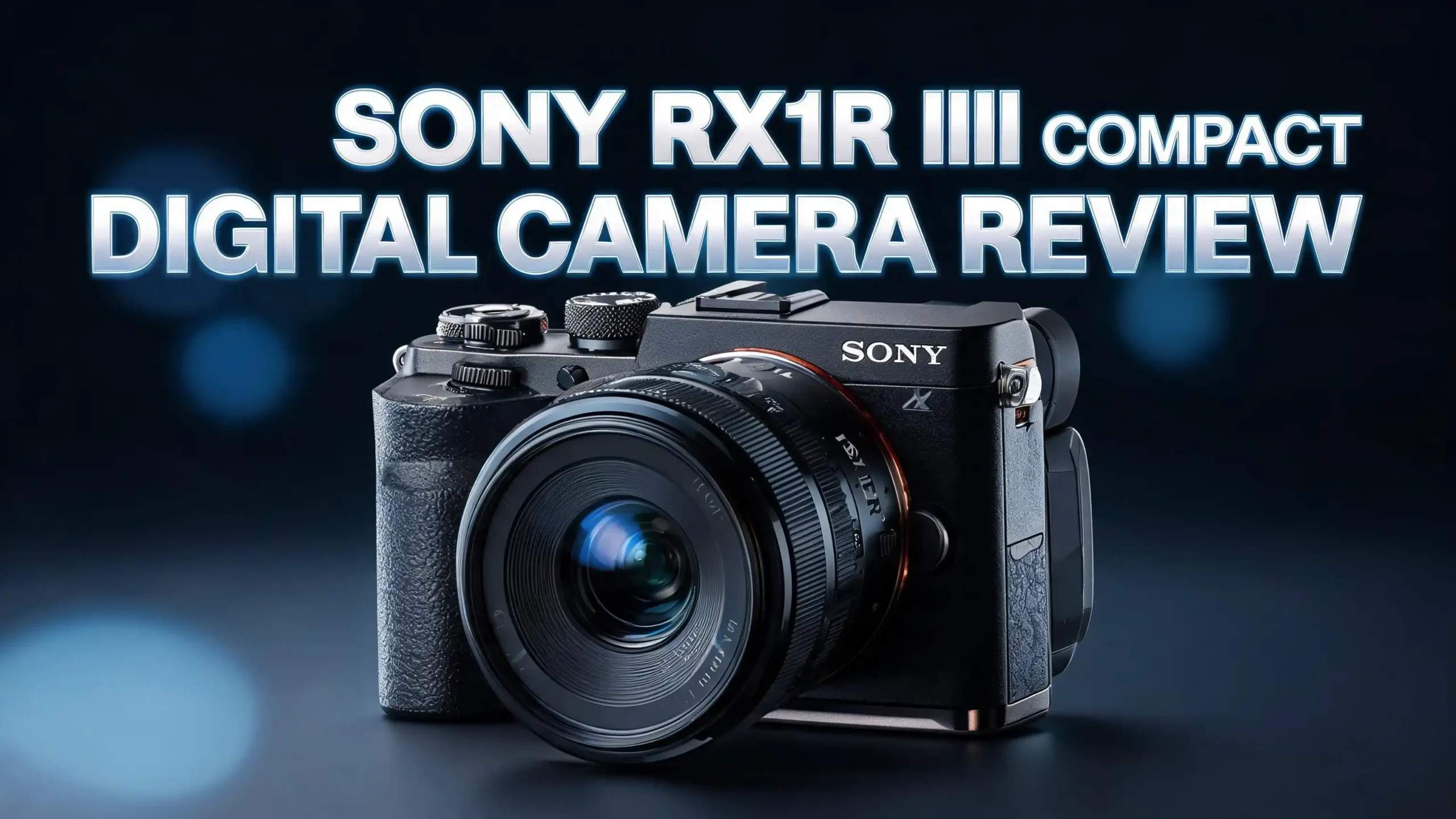
Sony RX1R III Compact Digital Camera Review 2026: The Pocket Full Frame King?
The Sony RX1R III is one of the most talked about cameras of the year. Sony made photographers wait nearly ten years for this update, and the result is a tiny full frame powerhouse. It packs a 61MP sensor inside a body you can almost slip into a coat pocket.
This review covers everything you need to know before spending five thousand dollars. I tested the camera across street, portrait, and travel scenarios. You will learn about its strengths, its real weaknesses, and how it compares to top rivals like the Fujifilm X100VI and the Leica Q3.
The RX1R III is not for everyone. It is a focused tool for a specific kind of shooter. By the end of this post, you will know if that shooter is you.
Key Takeaways
- The Sony RX1R III packs a 61MP full frame Exmor R sensor with the fixed ZEISS Sonnar T* 35mm f/2 lens, making it the smallest full frame fixed lens camera on the market today.
- It costs around $5,099 USD and ships in a magnesium alloy body that feels solid but stays under 500 grams in weight.
- The camera includes Sony’s BIONZ XR processor and a dedicated AI processing unit for fast subject recognition and tracking.
- Video tops out at 4K 30p, which feels limited for the price, but stills quality is class leading.
- The main weak points are a fixed rear LCD screen, no built in stabilization, and no weather sealing, which makes the value debate very real.
- Best buyers are street, travel, and documentary photographers who want one camera, one lens, and pure full frame image quality in a small bag.
What Is the Sony RX1R III?

- Exceptional 61MP resolution full-frame Exmor R CMOS sensor
- Micron-adjusted integrated lens / sensor optimizes performance

Last update on 2026-10-26 / Affiliate links / Images from Amazon Product Advertising API
The Sony RX1R III is a premium fixed lens compact camera. It uses a full frame 61MP sensor paired with a non removable 35mm f/2 ZEISS lens. Sony launched it in July 2025 as the long awaited successor to the RX1R II from 2015.
The camera targets serious photographers who want flagship image quality without carrying a full mirrorless kit. Think wedding pros who want a second body. Think travel writers who hate heavy bags. Think street shooters who want to stay invisible.
It is the smallest full frame camera you can buy today. The body is machined from magnesium alloy and feels dense in the hand. Sony stripped away the pop up viewfinder of the older model and built in a fixed 2.36 million dot electronic viewfinder instead.
This is a camera built around a clear philosophy. One focal length. One sensor. Pure focus on the image. That focus shapes every choice Sony made.
Sony RX1R III Design and Build Quality
The body measures just 113 by 67 by 88 millimeters and weighs about 498 grams with battery and card. That is remarkable for a full frame camera. You can hold it with one hand for hours without fatigue.
The magnesium shell feels premium and cold to the touch. Buttons click with a firm response. The top plate carries a dedicated exposure compensation dial and a step zoom lever for digital crop modes at 50mm and 70mm.
There is no weather sealing on this camera. That is a real concern at this price point. You need to be careful in rain or dusty conditions. The fixed 3 inch rear screen also feels dated next to tilting screens on cheaper rivals.
Grip is shallow but workable. I added an optional thumb rest and a small leather case for better handling. The minimalist look is the point. Sony designed this to disappear in your hand, and it succeeds.
ZEISS Sonnar T* 35mm f/2 Lens Performance
The fixed lens is the heart of this camera. Sony kept the same optical formula from the original RX1 but micro adjusted it for the new high resolution sensor. The result is a lens that resolves detail beautifully across the frame.
Center sharpness wide open at f/2 is excellent. Corners soften slightly but cleanup nicely by f/4. The lens shows the classic ZEISS rendering with smooth contrast, gentle color rolloff, and pleasing bokeh in the background.
Close focus distance is about 20 centimeters in macro mode. That gives you flexibility for food, product, and detail shots. The leaf shutter inside the lens lets you sync flash at any shutter speed up to 1/2000 second, which is a huge bonus for portrait shooters using off camera light.
The 35mm focal length is the classic documentary and street view. It feels natural, like the way your eyes scan a scene. If you love 35mm, you will love this lens. If you wanted 28mm or 50mm, look elsewhere.
Image Quality and 61MP Sensor
The back illuminated 61MP Exmor R sensor is the same one used in the Sony a7CR. Image quality is stunning at base ISO 100. You get massive 9504 by 6336 pixel files with deep dynamic range and clean color.
Skin tones look natural with that signature Sony look. Files have plenty of room for cropping. You can shoot wide and crop to a portrait without losing detail. This pairs perfectly with the digital step zoom modes.
Noise control is strong up to ISO 6400. Past that, grain starts to show, but files stay usable up to ISO 12800 for web use. The native range goes up to ISO 32000 and extends further if you need it for emergencies.
The sensor has no optical low pass filter, which means maximum detail rendering. You can see individual leaves on trees, fabric weave in clothing, and fine hair detail in portraits. It is the kind of file quality that rewards careful technique.
Top 3 Alternatives for Sony RX1R III
Before you commit to the RX1R III, look at these strong alternatives. Each one offers a different mix of features and price.

- 40.2MP X-Trans CMOS 5 HR Sensor
- Up to 6.0 stops In-Body Image Stabilization
Last update on 2026-10-26 / Affiliate links / Images from Amazon Product Advertising API

- Leica Q3: A groundbreaking digital camera renowned for its innovative features and performance...
- Triple Resolution Sensor: Featuring a first-ever 60MP BSI CMOS sensor with Triple Resolution...
Last update on 2026-10-26 / Affiliate links / Images from Amazon Product Advertising API

- When light is low and stakes are high, X100VI’s newly developed in-body image stabilization (IBIS...
- Confidently compose and view images using X100VI’s two-way tilting LCD. Featuring 1.62 million...
Last update on 2026-10-26 / Affiliate links / Images from Amazon Product Advertising API
The Fujifilm X100VI is the value pick at around $1,599. It uses an APS C sensor and a 23mm f/2 lens that gives a 35mm equivalent view. It also offers in body stabilization, a tilting screen, and the famous Fujifilm film simulations.
The Leica Q3 is the luxury rival at around $6,735. It pairs a 60MP full frame sensor with a wider 28mm f/1.7 Summilux lens. It also adds 8K video, a tilting screen, and the Leica brand prestige.
If you want a more flexible Fujifilm option, the X100VI in silver or black both deliver the same retro feel. Each of these cameras solves a slightly different problem, so pick based on your shooting style.
Autofocus and AI Subject Recognition
The RX1R III uses Sony’s 693 point hybrid autofocus system with a dedicated AI processing unit. This is the same AI chip from the Sony a7R V flagship. It recognizes humans, animals, birds, cars, trains, and insects automatically.
Eye autofocus locks on fast and tracks even when the subject turns away. Real time tracking holds onto moving subjects with impressive stickiness. I shot kids running in a park, and the camera nailed focus on the eye almost every frame.
In low light, autofocus stays snappy down to about minus 4 EV. It hunts slightly in very dim interiors but recovers quickly. The fixed lens helps here because the AF motor only has to move one element.
This is easily the best autofocus ever fitted to a fixed lens compact camera. It beats the Leica Q3 and the Fujifilm X100VI in tracking speed and accuracy. For street and event work, this matters every single shot.
Viewfinder and Rear Screen Experience
The new built in electronic viewfinder has 2.36 million dots and 0.7x magnification. It is not the highest resolution EVF on the market. But it is sharp enough for accurate framing and manual focus checks.
The fixed rear 3 inch touchscreen carries the same 2.36 million dot count. The lack of any tilt or flip mechanism is the biggest design complaint. Shooting from waist level or overhead becomes awkward in a way that feels out of step with 2026 cameras.
Touch response works well for focus point selection and menu navigation. You can swipe through images smoothly. The interface uses Sony’s latest menu system, which is far better than the old labyrinth menus from earlier RX models.
In bright sunlight, the EVF saves you when the LCD washes out. I found myself using the viewfinder about 80 percent of the time outdoors. Indoor and street work shifted more to the LCD.
Video Capabilities and Limitations
Video is the weakest part of the RX1R III package. The camera shoots 4K at up to 30p using a slight crop from the full sensor width. There is no 4K 60p mode and no 6K or 8K oversampling.
You do get S Log3 and S Cinetone color profiles for grading. Files come out clean at base ISO and hold up well in post. But rolling shutter is noticeable on fast pans, and there is no in body image stabilization to smooth handheld clips.
Full HD goes up to 120p for slow motion work. Audio recording uses the built in stereo mics or an external mic via the 3.5mm jack. There is no headphone jack for monitoring.
For occasional clips, the video is fine. For serious filmmaking, you should look at a Sony a7C II or an FX3. The RX1R III is a stills first tool, and Sony has been clear about that.
Battery Life and Storage
Sony swapped the tiny old battery for the larger NP FW50 type used across the alpha line. Battery life rates at about 300 shots per charge using the viewfinder. Real world results pushed me closer to 400 shots with mixed LCD and EVF use.
You can charge over USB C, which is a huge plus for travel. I powered the camera off a small power bank during a long shoot day. The camera also supports continuous USB power delivery for tethered work.
There is one SD card slot that supports UHS II speeds. Single slot will frustrate wedding and event pros who want instant backup. Most other buyers will not notice.
Carry one spare battery and one extra card and you are set for a full day. The big battery upgrade alone makes daily shooting much less stressful than the older RX1R II.
Sony RX1R III vs Fujifilm X100VI
The Fujifilm X100VI is the closest spiritual rival. It costs about one third of the price. So the question is simple. Is the Sony three times better?
The Sony wins on sensor size, resolution, and autofocus. Full frame at 61MP simply pulls more detail and cleaner low light files than the 40MP APS C Fuji sensor. The RX1R III also tracks subjects more accurately in fast moving scenes.
The Fujifilm wins on stabilization, film simulations, screen tilt, and the hybrid optical electronic viewfinder. It also wins on price by a wide margin. Many shooters will find the X100VI more fun day to day.
If image quality is everything, pick the Sony. If pure shooting joy and value matter more, pick the Fuji. Both are excellent cameras with very different personalities.
Sony RX1R III vs Leica Q3
The Leica Q3 is the prestige rival. It uses a similar 60MP full frame sensor and pairs it with a faster 28mm f/1.7 Summilux lens. It costs about $1,600 more than the Sony.
The Leica offers a wider field of view, faster aperture, in body stabilization, a tilting screen, and 8K video. It also has the Leica red dot and the brand experience that some buyers care about deeply.
The Sony fights back with a smaller body, better autofocus, and a more pocketable form factor. The 35mm focal length feels tighter and more classical for portraits and street work. Files from both cameras are gorgeous.
Choose Leica for the wider lens, the brand, and the build. Choose Sony for the size, the focal length, and the autofocus performance. Neither choice is wrong, and both deliver flagship results.
Who Should Buy the Sony RX1R III?
The RX1R III is a specialist tool, not a general camera. It rewards photographers who already know what they want. The ideal buyer loves 35mm, shoots a lot of stills, and wants the smallest possible full frame kit.
Travel photographers will love how it disappears in a bag. Street shooters will love the silent leaf shutter and the discreet body. Wedding pros will love it as a second camera for candid and reportage work.
You should skip this camera if you need video features, weather sealing, or zoom flexibility. You should also skip it if five thousand dollars feels like too much for a fixed lens body. The Fujifilm X100VI will serve you just as well for daily fun.
The RX1R III is a passion purchase for serious image makers. If the description fits you, it will become the camera you reach for every day.
Final Verdict on the Sony RX1R III
- Exceptional 61MP resolution full-frame Exmor R CMOS sensor
- Micron-adjusted integrated lens / sensor optimizes performance
Last update on 2026-10-26 / Affiliate links / Images from Amazon Product Advertising API
The Sony RX1R III delivers on its promise of pocketable full frame quality. The 61MP sensor and ZEISS lens combination produces files that rival full sized mirrorless cameras. The AI autofocus is the best in its class.
The compromises are real. No stabilization, no weather sealing, no tilting screen, and weak video specs make the price hard to justify on paper. The compromises feel less painful when you actually use the camera and see the results.
This is a camera for people who care about pictures more than features. It rewards patient shooting and clean composition. It will not solve every problem, but it will produce some of the best images of your life.
If you have the budget and you love 35mm, the RX1R III is one of the most rewarding cameras you can buy in 2026. If not, the Fujifilm X100VI is a brilliant and affordable starting point.
Frequently Asked Questions
Is the Sony RX1R III worth the price in 2026?
The RX1R III is worth it for serious stills photographers who value compact size and full frame image quality. The 61MP sensor and ZEISS lens combination is class leading. Casual users will find better value in the Fujifilm X100VI or a small mirrorless kit.
Does the Sony RX1R III have image stabilization?
No, the RX1R III does not include in body image stabilization. You need to rely on steady technique or higher shutter speeds. This is one of the most common complaints about the camera at this price point.
Can the Sony RX1R III shoot 4K video?
Yes, the camera records 4K video at up to 30 frames per second. It also offers Full HD at 120 frames per second for slow motion. There is no 4K 60p or 8K option, so it is not ideal for video first creators.
Is the lens on the Sony RX1R III interchangeable?
No, the ZEISS Sonnar T* 35mm f/2 lens is permanently fixed to the camera body. This is part of the design philosophy that keeps the camera small. If you want lens flexibility, look at the Sony a7C II instead.
How does the Sony RX1R III compare to the Leica Q3?
The Sony is smaller, lighter, and has faster autofocus with a 35mm lens. The Leica is larger and offers a wider 28mm f/1.7 lens, in body stabilization, and 8K video. The Sony costs about $1,600 less than the Leica Q3.
Does the Sony RX1R III have a weather sealed body?
No, the RX1R III does not offer weather sealing. You need to protect it from rain, dust, and extreme conditions. A small rain cover or a weather resistant bag is a smart investment for outdoor shooters.
What memory card works best with the Sony RX1R III?
The camera supports SD cards with UHS II speed ratings for the fastest write performance. A 128GB UHS II card from a reliable brand handles the large 61MP raw files well. There is only one card slot, so quality matters.

Hi, I’m Kate! As a tech journalist and gadget enthusiast, I’ve been exploring the intersection of artificial intelligence and consumer technology for over a decade. My passion lies in translating complex tech concepts into practical insights that actually matter to real people.